.png)


Listen on: Spotify Apple Podcasts Youtube
Written by Carolin Schönherr, CFA from Risk as Service & Alex Konoplyasty from Flashpoint
We stand at a pivotal moment in the evolution of global family enterprises. The anticipated $100 trillion intergenerational wealth transfer is already reshaping the way families think about governance, education, and capital stewardship. As the industry matures, family offices are shifting from informal units into sophisticated standalone entities, with KPMG’s Global Family Office Compensation Benchmark Report citing 77% now operating as independent organisations separate from the original family business.
This white paper explores how the professionalisation of family offices—in governance, education, and investment strategy—is the linchpin to building long-term resilience and purposeful wealth. Drawing on insights from leading global reports by Goldman Sachs, Bank of America, Citi, and Deloitte, this white paper presents a practical roadmap for evolving today’s family offices into future-ready platforms that can preserve and grow wealth across generations.
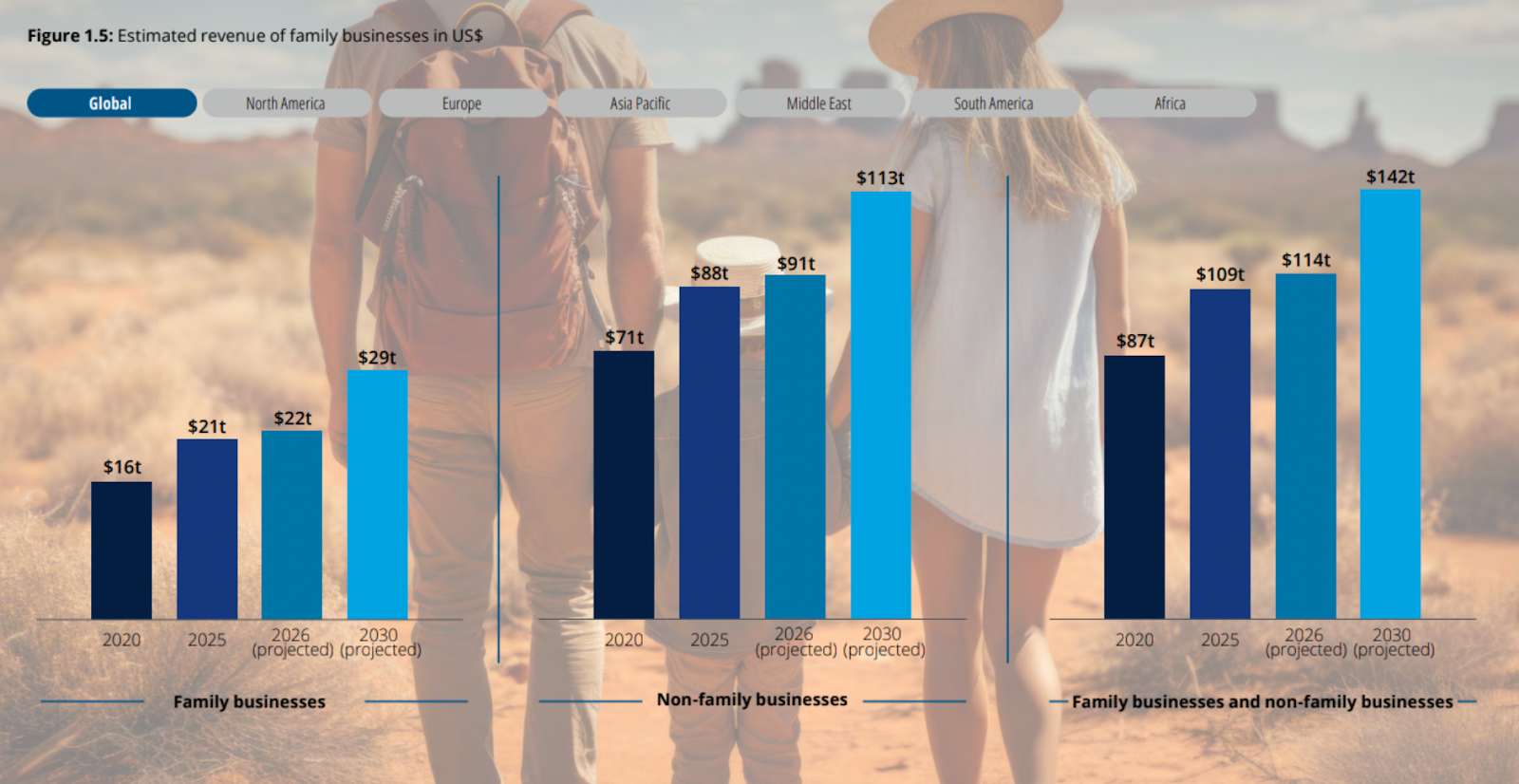
Family businesses are projected to reach $29 trillion by 2030 (Deloitte, 2025) and as part of this steady climb their dual imperative becomes ever more clear: to deliver strong financial performance while preserving the legacy and values of the family.
With nearly 80% of family businesses planning a generational transition in the next decade, the pressure to professionalise is growing. Succession is not merely a financial event; it is a test of governance, alignment, and operational readiness. As the next generation takes on leadership roles, families must confront complex questions about decision-making, communication, and long-term strategy.
Family offices are not just about capital preservation—they are about aligning wealth with identity, ambition, and values (MSFO Council, 2025).
Most family offices are lean by design—but stretched in function. As portfolios grow, operational complexity must be matched with scalable systems. And the 2025 Campden Wealth Family Office Operational Excellence Report highlights that while 62% of family offices identify governance as a top priority, a significant "execution gap" remains in formal documentation. This professionalisation gap shows heavily in the areas that are outside of the investment activity. "While family offices have made progress in professionalising their investment function, more improvement is needed in operational risk management, cybersecurity and leadership succession planning" (Citi, 2025).
Wealth continuity is as much a governance challenge as a financial one. Family offices managing more than US $1 billion in assets can reduce operational costs to as low as 36 basis points when they adopt formal governance frameworks (Campden, 2025).
Nearly 75% of family businesses are still in their first or second generation—historically the most fragile transitions. “Family is what threatens a family’s fortune” (Deloitte, 2025).
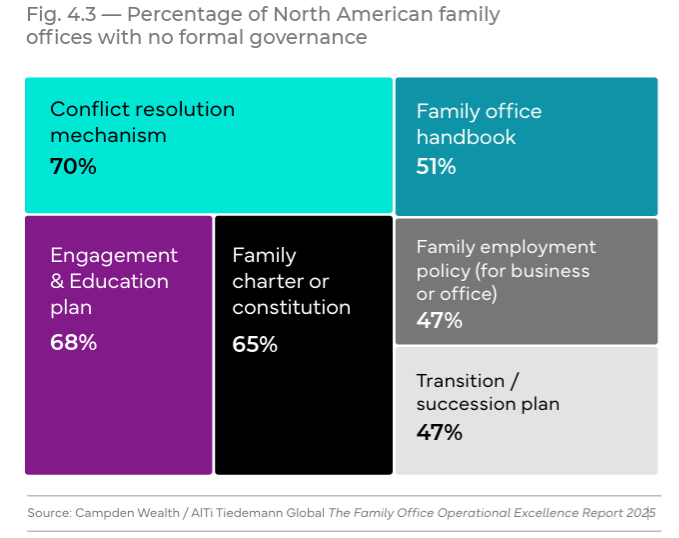
Key practices to protect the family legacy include:
Families that evaluate these choices with their generational transition in mind are more likely to define roles early, set expectations, and avoid succession shock. These are not decorative—they are operational levers that reduce fragmentation and promote alignment across generations. “It’s not just about legal structure—it’s about values, communication, and continuity” (Deloitte, 2025).
Next-Gen Readiness: The Role of Education, Mentoring & Ownership Transition
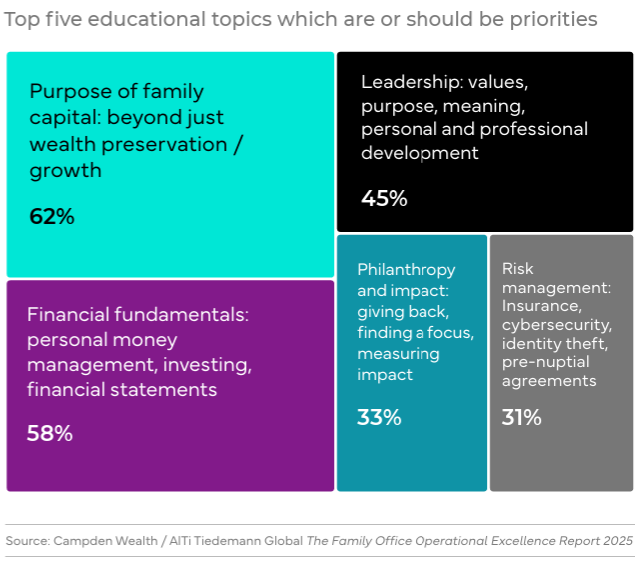
According to the Goldman Sachs Family Office Report 2025, only 45% say their heirs are “ready” to lead. The recognition of the critical risk of the heirs being unprepared has led to family offices shifting toward active learning models that align values and technical skills and support the shift from inheritance to participation. To start mentoring, training, and co-piloting investments. “Empowering next-gens requires more than board seats. It requires frameworks for learning, access, and governance immersion” (Deloitte, 2025).
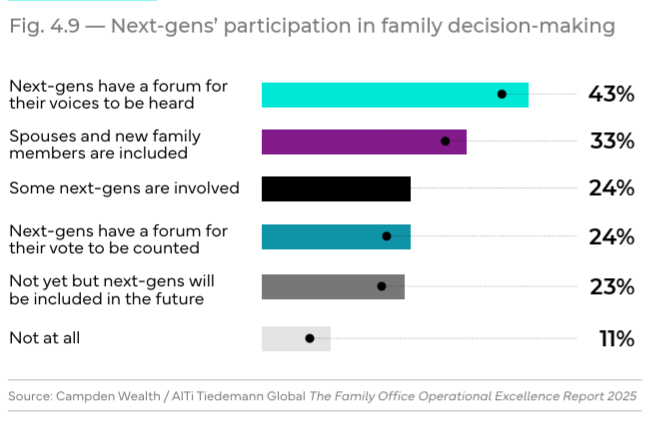
Yet, only one in four family offices has a formal next-generation mentoring program. The best-run family offices aren’t just teaching spreadsheet skills—they are investing in stewardship, driving conversations about values, purpose, governance, and long-term vision. UBS research notes that wealth transfer is not only about moving assets—it is equally about empowering the next generation to lead (UBS, 2025). Morgan Stanley also calls for education programs tailored to generational expectations and modern asset classes (Morgan Stanley, 2025). Goldman Sachs observes that over 70% of next gens are already active in strategic decision-making, yet few have undergone structured onboarding (Goldman Sachs, 2025).
Today’s family offices are doubling down on alternatives, digital assets, and ESG—but only 38% have clearly codified frameworks (Goldman Sachs, 2025). Family offices face mounting pressure to balance legacy strategies with frontier themes such as AI, private credit, and energy transition.
An effective Investment Policy Statement (IPS) acts as both compass and contract—yet many family offices lack this foundational document. On the investment front, the landscape is shifting: family-office portfolios now average roughly 50% traditional and 50% alternative assets, with private equity and real assets gaining share (Goldman Sachs, 2025).
Next-generation leaders are driving demand for thematic and impact investing, including artificial intelligence, cybersecurity, sustainability, and beyond. While return remains fundamental—28% of family offices anticipate returns above 10%—purpose is increasingly a co-pilot (Goldman Sachs, 2025).
For family offices to adjust effectively, they must balance vanguard opportunities with long-term operational resilience. It is less about chasing every trend than integrating emerging assets into a coherent portfolio structure that honors the family’s purpose and protects wealth across cycles.
Philanthropy is also evolving. No longer an afterthought, it is now interwoven with investment and governance decisions, helping align legacy, values, and wealth in a unified strategy.
The Road to the future-ready Family Office
The great wealth transfer is a process, not an event. Families that thrive in the coming decades will be those that invest in governance, education, and intentional capital deployment as rigorously as they manage their portfolios.
Future-ready family offices share several characteristics: they embrace structured governance, distribute decision-making across generations, and operationalise values. They recognise that professionalisation is no longer optional but a strategic imperative.
Morgan Stanley (2025) notes that sustainability for family offices means evolving with purpose, not merely preserving wealth. The most successful families will not only transfer wealth but also transfer purpose, ensuring that education, governance, and investment strategy work together to preserve and grow legacy over generations.
We invite you to take the next step.
If this paper has prompted reflection or new ideas, our team is available to support your journey. We offer: